

Donna Salli grew up in an iron-mining town in Michigan’s Upper Peninsula, where Lake Superior dominates the landscape. Like the characters in her novel A Notion of Pelicans, she has a fascination for the big lake.
Her family also lived, when she was in first grade, with her paternal grandparents on their northern Wisconsin dairy farm. The house had a single water faucet in the kitchen that delivered icy cold water from the well. The house had no hot water, no central heat, no toilet or bath. There was an outhouse, and a sauna that her Finnish immigrant grandparents had built by hand. In that primitive setting, she was given a deep love for the written word. Every night as her mother tucked Donna and her younger brother into bed, she read poetry and stories to them.
Donna writes in multiple genres—poetry, fiction, drama, and the essay. Her creative work focuses on family, heritage, spirituality, and the changing landscape of contemporary life.
For more information about her education, publication, and interests, click here.
Latest Blog Posts ~ Click Photo

Good Lord: A Houseplant Story
The long, curving driveway between tall trees was lovely. The ring of pines around the house made the yard feel like a cathedral. But it wasn’t those things that caught me. Just as I put the car into Park, a momma deer and her fawn peeked around the corner of the house and looked at me quizzically. That was it. My sister was with me, helping me search for a new home. Seeing the deer, she inhaled in delight and said, “Oh, this is your house!” She was right. Within hours, my husband and I had made an offer and had it accepted. Now here we are, neighbors to those sweet deer. Having thrown over the old life we knew, we still wonder, some days at least, What have we done?

The Mirror
I once imagined that a writer sits around with a martini and a typewriter, leisurely typing, as the Pulitzers and Nobel prizes roll in. What a pile of horse manure. My husband Bruce and I are writers. There had better be a damn good reason to interrupt when the other one is in the throes of working on something. It’s like looking in the mirror. What I do, he does. He’ll be at his desk, I walk in, and the hand flutters up, warning me away, followed by the sideward glance, and the glance always does it. I start thinking—today, about places I’ve lived. Some have been memorable, like an apartment where the landlady lived downstairs, her two deceased Pekingese dogs mounted and displayed in a lighted glass case. It was a bit unnerving, but now I see the love she had for them, and likely the loneliness. The place I think about most, though, isn’t that one. It was a corner apartment next to a funeral chapel, the apartment with a voice in the mirror.

Schrödinger’s Cat: A Story from the Almost Real World
Strange things happen, unexpected things, here at my house. It’s in a quiet woods, a small stream running just behind. We live with turkeys, squirrels, and deer, and the more elusive coyote and fox. Day and night, they amble or scurry by, just off the patio. Decades ago, I left my first teaching job, got married, joined my husband here. I’ve lived by the mantra that things work out. I’d been an assistant professor and had a decision to make: stay, and go where the job would lead me? or leave for love? I chose love. And yes, I eventually began teaching again. Now retired, and lately feeling the need to challenge my aging brain cells, I’ve been ending my days bundled up in bed, reading about quantum physics. That brings me to my late friend Ralph, who is strangely wrapped up in this story. An aging bachelor, his office was next to mine at that first job. It, oddly, brings me, too, to Schrödinger’s cat, the hypothetical cat in a hypothetical box, who is dead or alive when the box is opened—one theory being that its fate is determined, somehow, by being observed. Don’t worry. The heart of this story is not physics.
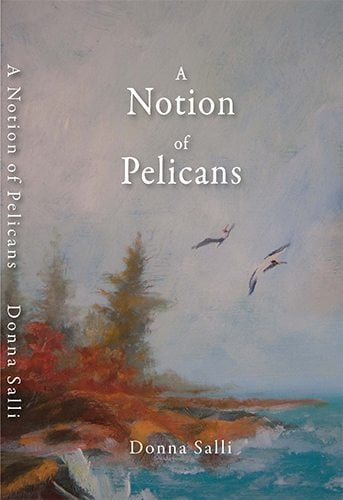
A Notion of Pelicans – by Donna Salli
On a windblown bluff above Lake Superior sits a fieldstone church. Founded one hundred years ago after a puzzling encounter with a flock of pelicans left Lavinia with a curious notion, Pelican Church still draws inquisitive souls to its pews with the legend that one solitary bird still circles overhead, watching.
These people have notions of their own — a pastor’s wife wants a honeymoon, a professor has harebrained ideas, a business owner is in everyone’s face, a young actress can do or be anything onstage yet struggles with every real-life decision — and their stories, tucked away for years, unfold and glide onto the pages of Donna Salli’s intimate debut novel.
The people of Pelican Church are oh-so-human and expose their mix of shifting hopes and obsessions, protected infidelities, and notions gone awry as one October day swings from sunup to sundown under the watchful gaze of a single pelican.

